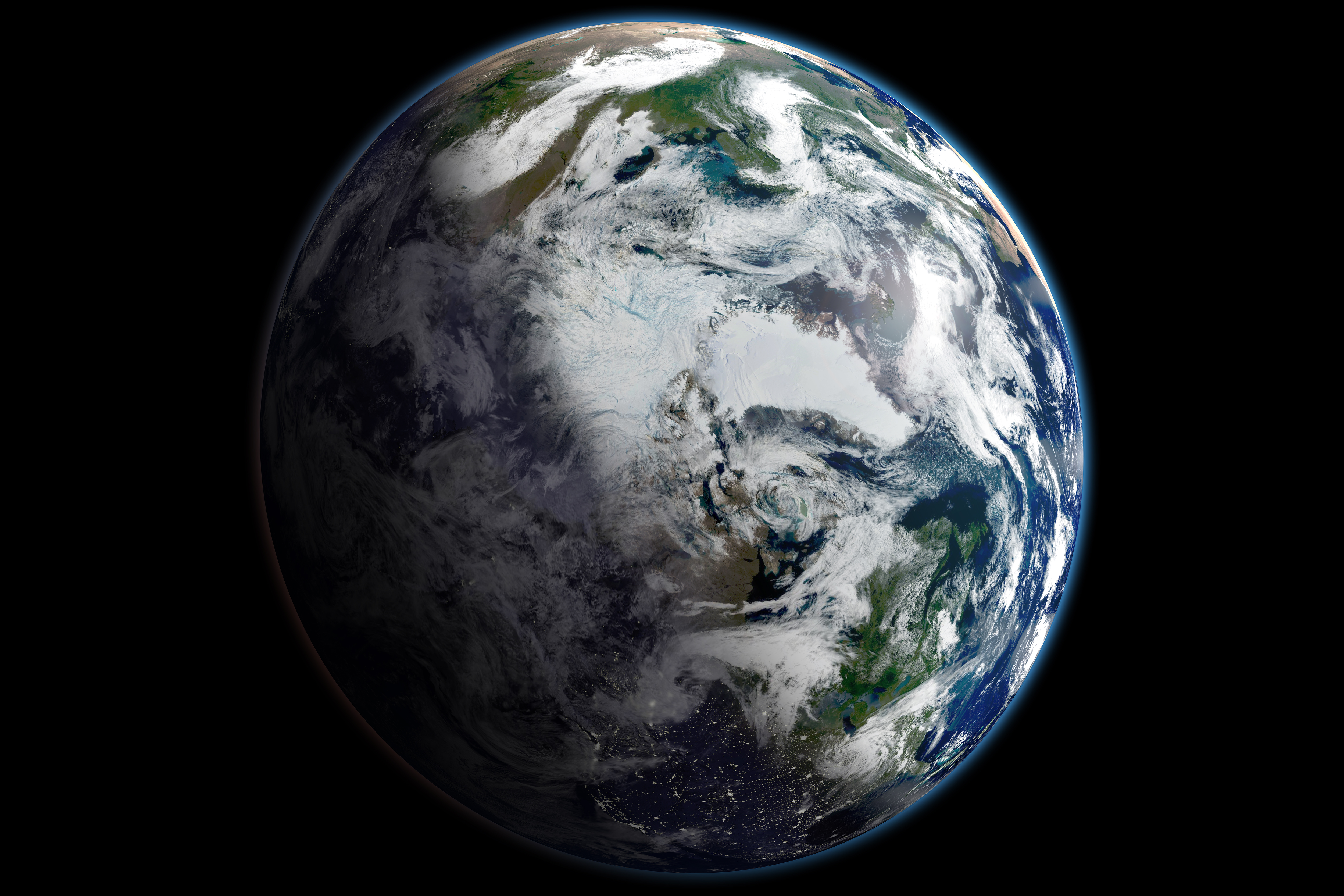
The Arctic could see its first ice-free September as early as 2033 under a high-emission scenario, or 2037 under a moderate one, according to a new observationally-constrained study in Climate Dynamics. The projections, which correct for model biases using attribution analysis, advance the timing by roughly a decade compared to unconstrained models (Springer, 2026).
An "ice-free" Arctic is defined as sea ice area below 1 million square kilometers, down from a historical summer minimum of roughly 5 to 7 million square kilometers. The threshold means the central Arctic basin would be effectively open ocean during the September minimum, navigable and exposed to sunlight (NSIDC, 2026).
Why is the timeline moving up?
The new study uses an optimal fingerprinting strategy to attribute Arctic sea ice decline to greenhouse gas forcing, then scales model projections to match the observed trend. This corrects a known bias in CMIP6 models, which underestimate the observed rate of decline. Early climate models predicted ice loss of roughly 2.5 percent per decade, while satellite observations showed the real rate was closer to 8 percent per decade (The Conversation, 2023). The result advances the projected ice-free date by about 10 years under high emissions and 20 years under moderate emissions.
| Scenario | Original projection | Observationally constrained | Change |
|---|---|---|---|
| High emissions (SSP5-8.5) | ~2050 | 2033 | 17 years earlier |
| Moderate emissions (SSP2-4.5) | ~2055 | 2037 | 18 years earlier |
| Low emissions (SSP1-2.6) | Uncertain / late century | 2040s | Substantially earlier |
What does "ice-free" really mean?
It does not mean an ocean entirely devoid of ice. Some ice will continue to form along the northern coast of Greenland and within the Canadian Arctic Archipelago. The threshold of 1 million square kilometers is set at the level below which the central Arctic basin would be effectively open ocean during the September minimum (NSIDC, 2026). That threshold sounds large, but it represents an 82 percent reduction from the 1981-to-2010 summer average of roughly 6 million square kilometers.
We basically are saying that it has become too late to save the Arctic summer sea ice.
— Dirk Notz, IPCC contributor, Nature Communications (Min et al., 2023)
A 2023 study in Nature Communications by Seung-Ki Min and colleagues at Pohang University and the University of Hamburg confirmed that the first ice-free September will likely occur in the 2030s under all emissions scenarios, including the most ambitious low-emissions trajectory. Their observationally constrained approach adjusted model projections to match the actual rate of decline measured by satellites over four decades (Nature Communications, 2023).
The albedo feedback loop accelerates everything
The loss of sea ice is not just a symptom of warming. It actively makes warming worse. Sea ice reflects roughly 80 percent of incoming sunlight back to space, while open ocean water absorbs about 90 percent of it. When ice is replaced by water, the Arctic Ocean absorbs substantially more solar energy, which heats the water, warms the surrounding atmosphere, and melts more ice. Scientists call this a positive feedback loop, and it is one of the main reasons the Arctic is warming faster than anywhere else on Earth.
Over the past 40 years, multiyear sea ice, the thick ice that survives multiple summers, has shrunk from roughly 7 million square kilometers to about 4 million. That loss is equivalent to the size of India or twelve times the area of the United Kingdom, a visible and dramatic signal of fundamental change to the climate system (The Conversation, 2023).
Why is the Arctic warming four times faster?
Arctic amplification, the phenomenon where the Arctic warms disproportionately faster than the global average, is driven by several reinforcing mechanisms. The ice-albedo feedback described above is the most visible, but others play major roles. As sea ice thins and retreats, more open water is exposed to winter winds, which transfers heat from the ocean to the atmosphere. Decreased snow cover on land reduces surface reflectivity across northern regions. Changes in atmospheric and oceanic circulation patterns also transport additional heat poleward.
- Multiyear ice loss: 7M km² to 4M km² in four decades
- Ice-albedo feedback: ice reflects 80% of sunlight, ocean absorbs 90%
- Arctic amplification: polar warming runs 4x the global rate
- Multiyear ice that survives multiple summers is declining fastest
What happens to weather patterns worldwide?
An ice-free Arctic does not stay a local problem. The diminishing temperature gradient between the Arctic and lower latitudes destabilises the polar jet stream, the high-altitude river of air that steers weather across the Northern Hemisphere. A weaker, wavier jet stream allows cold Arctic air to plunge farther south in winter and hot air to push farther north in summer, producing more extreme and persistent weather events across North America, Europe, and Asia.
Research published in 2023 analysis of ice-free Arctic implications found downstream effects include disruption of mid-latitude storm tracks, accelerated Greenland ice sheet melting, and progressive thaw of Arctic permafrost. The Greenland melt contributes directly to sea-level rise, unlike sea ice melting itself. Permafrost thaw releases methane and carbon dioxide stored in frozen organic matter, creating another self-reinforcing warming loop (The Conversation, 2023).
The consequences for ecosystems and people
The Arctic marine ecosystem is built around the seasonal sea ice cycle. Ice algae that grow on the underside of sea ice form the base of a food web that supports Arctic cod, ringed seals, narwhals, belugas, and polar bears. When ice disappears in summer, that food web collapses from the bottom up. Polar bears already face longer fasting seasons as hunting platforms shrink. Walruses are forced into crowded coastal haul-outs where stampedes kill calves. Ivory gulls, one of the most ice-dependent Arctic seabirds, have declined by more than 80 percent in Canada since the 1980s.
Roughly 4 million people live in the Arctic regions of the eight Arctic Council countries, including about 400,000 Indigenous people from more than 40 distinct ethnic groups. Their traditional food systems, transportation routes, and cultural practices are closely tied to a reliably frozen sea. Coastal communities already face accelerating erosion as the protective buffer of sea ice vanishes and permafrost under foundations thaws.
The geopolitical and economic scramble
An ice-free Arctic simultaneously opens shipping routes closed for all of recorded history. The Northern Sea Route along the Russian coast, the Northwest Passage through Canadian waters, and a potential central Transpolar route will become reliably navigable during summer months. Container ships traveling from Northeast Asia to Northern Europe could save roughly 40 percent of the distance compared to the traditional Suez Canal route.
| Route | Distance (approx.) | Time saved | Status |
|---|---|---|---|
| Suez Canal (traditional) | ~21,000 km | Baseline | Open year-round |
| Northern Sea Route | ~13,000 km | ~35-40% | Seasonal, expanding |
| Northwest Passage | ~14,000 km | ~30% | Seasonal, ice-choked |
Energy resources beneath the Arctic seafloor are estimated at about 13 percent of the world's undiscovered oil and 30 percent of its undiscovered natural gas. Russia, the United States, Canada, Norway, Denmark via Greenland, and increasingly China, which has declared itself a near-Arctic state, are actively positioning themselves for the strategic competition an open Arctic Ocean will produce (SpaceDaily, 2026).
What happens after the threshold is crossed?
The first ice-free year is unlikely to be permanent. Winter ice will continue to form for additional decades, and year-to-year variability will persist. A single extreme weather year could produce the first ice-free day even before 2030, according to a 2024 paper in Nature Communications by Heuzé and colleagues. But once the threshold is crossed, it will be crossed with increasing frequency. The long-term direction is clear: the Arctic is heading toward a late-summer configuration of reliably open water.
The change is not reversible on any timescale relevant to human institutions. The Arctic has carried summer ice for roughly 115,000 years, through the entire emergence of modern civilisation. The last time it was seasonally ice-free was the Eemian interglacial, about 130,000 to 115,000 years ago, before sustained human migration out of Africa, before agriculture, before recognisable language families had differentiated. Most people alive today will live to see the Arctic Ocean lose its summer ice for the first time since before our species left Africa.
- Ice-free threshold: sea ice area below 1 million km²
- Earliest projection: 2033 (high emissions), 2037 (moderate emissions)
- Historical summer minimum: roughly 5-7 million km²
- Multiyear ice declined from 7M km² to 4M km² in four decades
- Arctic warming runs four times the global average rate
- Last ice-free period was the Eemian, ~115,000 years ago
- First ice-free day could come even earlier than first ice-free month
- Consequences span ecosystems, weather, geopolitics, and Indigenous communities
- Springer — Observationally-constrained projections of September ice-free Arctic
- NSIDC — What do scientists mean by "ice-free Arctic"?
- Nature Communications — Observationally-constrained projections (Min et al., 2023)
- SpaceDaily — Most people alive today will see the Arctic lose its summer ice
- The Conversation — Arctic Ocean could be ice-free in summer by 2030s
- Fusion's Break-Even Moment: Reality or Lab Fiction
- Lunar Moon Mining: The Next Resource Rush
- The Dead Internet Theory, Now With Proof
When will the Arctic be ice-free?
As early as 2033 under high emissions, or 2037 under moderate. The threshold is sea ice below 1 million square kilometers — an 82% reduction from the historical average.
What does an ice-free Arctic mean for weather?
It destabilizes the polar jet stream, causing more extreme weather across North America, Europe, and Asia. Greenland melt also contributes to sea-level rise.
How long has the Arctic had summer ice?
For roughly 115,000 years. The last ice-free period was the Eemian interglacial, 130,000-115,000 years ago. Most people alive today will witness the change.
Bottom line
The change is not reversible on any timescale relevant to human institutions. The Arctic has carried summer ice for roughly 115,000 years, through the entire emergence of modern civilisation. The last time it was seasonally ice-free was the Eemian interglacial, about 130,000 to 115,000 years ago, before sustained human migration out of Africa, before agriculture, before recognisable language families had differentiated. Most people alive today will live to see the Arctic Ocean lose its summer ice for the first time since before our species left Africa.
What we still don't know
This is a fast-moving story. We update the post as new facts land — and we'll flag it when we do.
Enjoyed this? Pay it forward
A sharp story is worth passing on. Share it with the people who read tech like it matters.