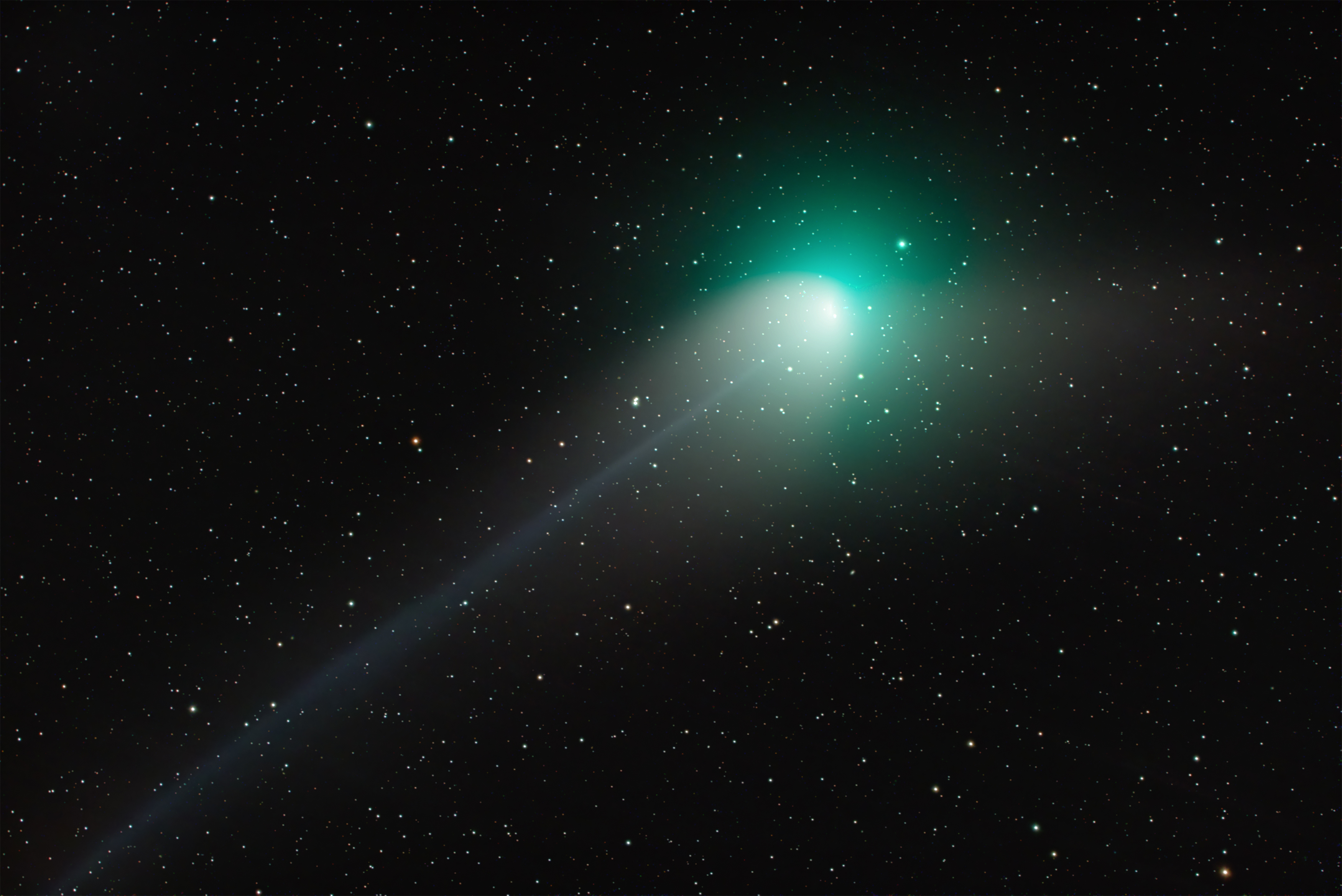
Interstellar comet 3I/ATLAS is the third object ever confirmed to originate from beyond our solar system. It made its closest approach to Earth on December 19, 2025, passing within 167 million miles (269 million kilometers) of our planet. The encounter gave astronomers their first chance to study an interstellar visitor with both the Hubble and James Webb Space Telescopes, and the results rewrote what we know about the stuff between stars (PBS NewsHour, 2025).
The comet was discovered on July 1, 2025, by the NASA-funded ATLAS survey telescope in Rio Hurtado, Chile. It arrived from the direction of the constellation Sagittarius and is traveling on a hyperbolic orbit so extreme it will never be captured by the Sun's gravity. The object poses no threat to Earth and will eventually leave the solar system forever (NASA, 2025).
How was 3I/ATLAS discovered?
The ATLAS (Asteroid Terrestrial-impact Last Alert System) telescope in Chile first picked up the object at apparent magnitude 18, far too faint for the naked eye. At discovery, 3I/ATLAS was entering the inner solar system at 61 kilometers per second relative to the Sun, located about 3.5 AU from Earth and 4.5 AU from the Sun (NASA, 2025). Follow-up observations from the Zwicky Transient Facility at Palomar Observatory soon confirmed the trajectory was unbound, meaning the object was not from around here.
Pre-discovery images pushed the record back to at least May 7, 2025, when NASA's TESS satellite captured the comet already showing activity at roughly 6.4 AU from the Sun. That early outgassing suggests volatile ices other than water were driving its coma long before it reached the warmth of the inner solar system (Wikipedia / TESS data, 2025).
How old is 3I/ATLAS?
A study published in Nature in June 2026 concluded that 3I/ATLAS could be up to 12 billion years old, nearly three times the age of our solar system, which formed about 4.5 billion years ago. The comet's ratio of deuterium to hydrogen is roughly 10 times higher than anything measured in local comets, pointing to formation in an environment that was minus 243 degrees Celsius. That makes it among the coldest objects ever observed in our solar neighborhood (CBS News / AFP, 2026).
Lead study author Martin Cordiner of NASA's Goddard Space Flight Center told AFP that the comet 'may be the oldest object ever observed in our solar system.' The isotopic fingerprint also hints that 3I/ATLAS could be a relic from 'cosmic noon,' an era roughly 10 billion years ago when star formation across the Milky Way peaked. If that origin holds, the comet spent billions of years wandering the galaxy before stumbling into our neighborhood (CBS News / AFP, 2026).
What did the telescopes find?
The Hubble Space Telescope detected the comet's nucleus in July 2025, estimating a diameter between 0.32 and 5.6 kilometers, with the actual size likely under 1 kilometer once the dusty coma is accounted for. That still makes 3I/ATLAS larger than the nuclei of both previous interstellar visitors: 1I/'Oumuamua at about 0.16 km across and 2I/Borisov at roughly 0.4 km (Hubble observations, 2025).
JWST's NIRSpec instrument observed the comet on August 6, 2025 and again in December after perihelion. The infrared spectra revealed an unusually CO2-rich coma with a CO2-to-water mixing ratio of 8.0, one of the highest ever recorded in a comet. Small amounts of water ice, water vapor, carbon monoxide, carbonyl sulfide, and methane were also present. By December, mid-infrared data added the first detection of methane and confirmed the coma's evolving chemistry (Wikipedia / JWST data, 2025).
| Species | Emission Rate | Source |
|---|---|---|
| Carbon dioxide (CO2) | 129 kg/s | JWST, Aug 2025 |
| Water (H2O) | 6.6 kg/s | JWST, Aug 2025 |
| Carbon monoxide (CO) | 14 kg/s | JWST, Aug 2025 |
| Cyanide (CN) | 17.6 g/s | VLT, Aug 2025 |
| Nickel (Ni I) | 4.6 g/s | VLT, Jul-Aug 2025 |
The Very Large Telescope also detected cyanide gas and atomic nickel vapor in the coma, concentrations similar to those seen in solar system comets. Curiously, no iron vapor was detected alongside the nickel, which is unusual since the two metals typically appear together in cometary outgassing. The absence of carbon-chain compounds like C2 and C3 makes 3I/ATLAS one of the most carbon-depleted comets ever cataloged (VLT observations, 2025).
Is there any alien technology?
The SETI Institute conducted extensive radio scans of 3I/ATLAS using its Allen Telescope Array in Northern California and found no signs of artificial signals. Sofia Sheikh led the analysis, which ruled out the 'alien technology' hypothesis that had gained traction online after Harvard professor Avi Loeb suggested keeping all possibilities open. NASA and SETI both confirmed the object is completely natural (AP News, 2026).
We should put all possibilities on the table that it's a rock, a comet, or something else until we get the evidence, the data that will tell us what it is.
— Avi Loeb, Harvard University, to CBS Boston
SETI's conclusion was definitive: the comet shows no technosignatures. Its spectral emissions match natural cometary chemistry, and the isotopic ratios are consistent with formation in an ancient, cold region of the galaxy rather than with any engineered origin (CBS News / AFP, 2026).
How does 3I/ATLAS compare to previous interstellar visitors?
Three confirmed interstellar objects have now passed through our solar system, and each one tells a different story. 1I/'Oumuamua, spotted in 2017, was elongated and showed no coma. 2I/Borisov, detected in 2019, was a more conventional comet that fragmented near perihelion. 3I/ATLAS is by far the best studied, thanks to its longer visibility window and the combined firepower of Hubble, JWST, and ground-based observatories (PBS NewsHour, 2025).
| Object | Year | Nucleus Size | Eccentricity | Closest to Sun |
|---|---|---|---|---|
| 1I/'Oumuamua | 2017 | ~0.16 km | 1.2 | 0.26 AU |
| 2I/Borisov | 2019 | ~0.4 km | 3.4 | 2.01 AU |
| 3I/ATLAS | 2025 | <1 km | 6.14 | 1.36 AU |
3I/ATLAS has the highest eccentricity of the three at 6.14, meaning its trajectory through the solar system was nearly a straight line rather than a curve. It also arrived faster: 58 km/s relative to the Sun, compared to 26 km/s for 'Oumuamua and 32 km/s for Borisov. The speed and angle suggest it originated from the Milky Way's thick disk, a region of older, metal-poor stars (Wikipedia / orbital data, 2025).
What about the comet's tail and coma?
By mid-September 2025, the visible dust tail stretched roughly 100,000 kilometers, and by April 2026 the ESA reported gas emissions extending 5 million kilometers from the nucleus. The coma reached a diameter of about 26,000 kilometers in July 2025 and grew larger as the comet approached the Sun. A distinctive Sun-facing plume, not a tail but a dust jet from the heated surface, was visible in Hubble images throughout the summer (ESA / Hubble, 2025).
Spectroscopic analysis showed the coma had a reddish color similar to D-type asteroids and Solar System comets, likely caused by irradiated organic compounds called tholins. Mid-infrared data from JWST's MIRI instrument revealed no crystalline silicates, only amorphous silicates resembling material found in the interstellar medium. That lack of crystalline minerals is further evidence the comet formed in a cold, distant region and was never processed through the turbulent interior of a protoplanetary disk (Wikipedia / JWST MIRI data, 2025).
What happens to 3I/ATLAS now?
The comet passed closest to the Sun on October 29, 2025, at 1.36 AU, between the orbits of Earth and Mars. It then swung past Earth on December 19 at 1.8 AU and is now heading out of the solar system on its permanent exit trajectory. Astronomers expect it will reach the inner Oort cloud, roughly 2,000 AU from the Sun, around the year 2189 (Wikipedia / orbital calculations, 2025).
Future observations will become increasingly difficult as the comet recedes. Hubble and JWST will continue monitoring for as long as the object remains detectable, but the data will thin out rapidly. 'The comet is now leaving the solar system and will never return, so future observations will become increasingly difficult,' astronomer Peter Veres told AFP (CBS News / AFP, 2026).
What comes next for interstellar object hunting?
Astronomers expect to spot many more interstellar objects in the coming years, thanks largely to the Vera C. Rubin Observatory in Chile. Rubin's 8.4-meter Simonyi Survey Telescope and 3.2-gigapixel camera began full survey operations in July 2026, imaging the entire southern sky every few nights. Scientists estimate Rubin could discover dozens of interstellar objects over its ten-year Legacy Survey of Space and Time (Rubin Observatory, 2026).
The European Space Agency's Comet Interceptor mission, planned for launch between 2028 and 2029, will park a spacecraft at the Sun-Earth L2 point and wait up to three years for a suitable target, including the possibility of an interstellar interloper. The mission's three-spacecraft design will deploy two small probes to sample the coma from different distances, building a 3D chemical profile no single spacecraft could achieve (ESA / Comet Interceptor, 2026).
- Discovered July 1, 2025 by the ATLAS survey telescope in Chile
- Closest approach to Sun: October 29, 2025 (1.36 AU)
- Closest approach to Earth: December 19, 2025 (1.8 AU)
- Nucleus diameter: less than 1 km, per Hubble imaging
- Estimated age: up to 12 billion years, per Nature study (2026)
- Coma CO2-to-water ratio: 8.0, among the highest ever recorded
- No alien technosignatures detected by SETI Institute
- NASA — NASA Discovers Interstellar Comet Moving Through Solar System
- PBS NewsHour — Interstellar comet 3I/Atlas closest approach to Earth
- CBS News — Interstellar comet could be oldest object ever seen in solar system
- Wikipedia — 3I/ATLAS full observation history and composition data
- ESA — Comet Interceptor mission overview
- Starship's Orbital Refueling Test: The Results Are In
- Fusion's Break-Even Moment: Real or Lab Fiction
- The Lunar Economy: Mining the Moon Gets Serious
How old is comet 3I/ATLAS?
Up to 12 billion years old — nearly 3x the solar system's age. Its deuterium ratio is 10x higher than local comets, pointing to formation at minus 243 degrees Celsius.
Is 3I/ATLAS dangerous to Earth?
No. It passed closest on December 19, 2025 at 269 million km and is heading out of the solar system permanently. It will never return.
Did SETI find alien technology?
No. Radio scans found no artificial signals. Spectral emissions match natural cometary chemistry.
Bottom line
The European Space Agency's Comet Interceptor mission, planned for launch between 2028 and 2029, will park a spacecraft at the Sun-Earth L2 point and wait up to three years for a suitable target, including the possibility of an interstellar interloper. The mission's three-spacecraft design will deploy two small probes to sample the coma from different distances, building a 3D chemical profile no single spacecraft could achieve (ESA / Comet Interceptor, 2026).
What we still don't know
This is a fast-moving story. We update the post as new facts land — and we'll flag it when we do.
Enjoyed this? Pay it forward
A sharp story is worth passing on. Share it with the people who read tech like it matters.