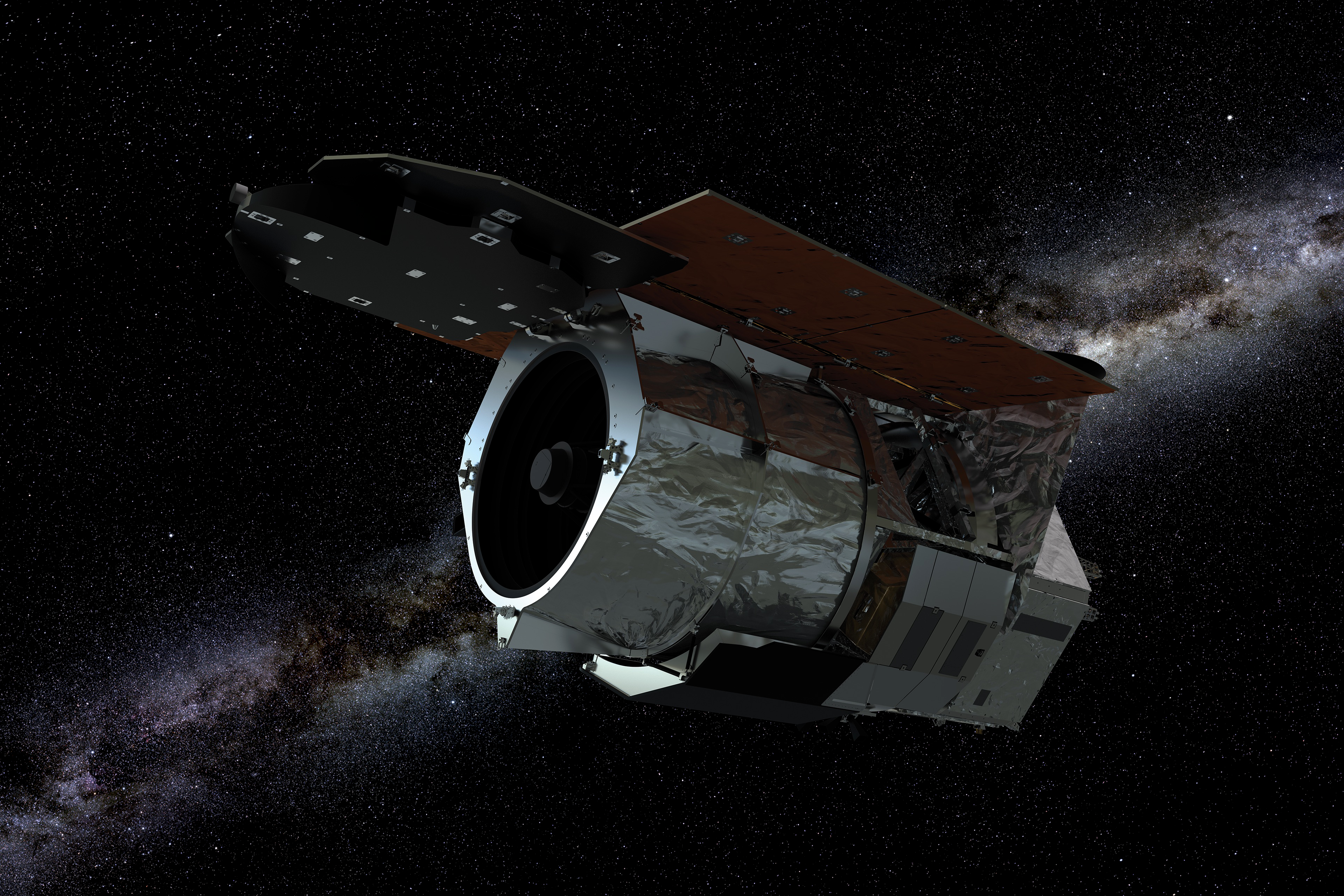
NASA's Nancy Grace Roman Space Telescope is set to launch on August 30, 2026, aboard a SpaceX Falcon Heavy from Kennedy Space Center, about eight months ahead of schedule. Named after NASA's first chief astronomer, Roman shares the same 2.4-meter mirror as Hubble but with a field of view roughly 100 times larger (NASA, 2026).
Roman is not a JWST replacement, it is a JWST complement. JWST stares deeply at tiny areas of sky, while Roman surveys wide swaths. A typical Roman pointing sees as much sky as 100 JWST pointings, but with shorter integration times. The two missions will collaborate on follow-up: Roman finds the candidates, JWST characterizes them (James Webb Tracker, 2026).
What makes Roman different from Hubble and JWST?
Roman's 2.4-meter primary mirror was originally built for a National Reconnaissance Office program and donated to NASA in 2012, a windfall that cut both cost and schedule risk (James Webb Tracker, 2026). The optics behind that mirror are entirely different from Hubble's though. Roman pairs the same aperture with a much larger focal plane: 18 detectors in a 3-by-6 mosaic covering 0.28 square degrees per pointing. Hubble's WFC3 sees about one-hundredth as much sky in a single image.
The wavelength coverage runs from about 0.5 to 2.3 microns, visible through near-infrared. JWST works almost entirely in the infrared, from 0.6 to 28 microns. The two telescopes complement each other in a simple division of labor. Roman is wide and fast. JWST is deep and detailed. Both will operate at the Sun-Earth Lagrange point L2, roughly 1.5 million kilometers from Earth (James Webb Tracker, 2026).
What will Roman do?
Roman's three flagship surveys target dark energy, exoplanet microlensing, and the structure of the cosmic web. The High-Latitude Wide-Area Survey will cover roughly 2,000 square degrees in five filters, providing the lensed-galaxy statistics needed for dark-energy constraints. The Galactic Bulge Time Domain Survey will monitor dense star fields toward the Milky Way's center for microlensing events. The Supernova Survey will repeatedly image patches of high-latitude sky to detect Type Ia supernovae out to high redshift (NASA, 2026).
What instruments does Roman carry?
The Wide Field Instrument, or WFI, is the science engine. It is a 300.8-megapixel camera providing multiband imaging and slitless spectroscopy from visible to near-infrared wavelengths. Eight science filters plus a prism and grism assembly let scientists choose which colors of light to capture for each observation. The detector array is composed of 18 H4RG-10 detectors from Teledyne Technologies, giving Roman its unmatched field of view (NASA, 2026).
The second instrument is the Coronagraph Instrument, or CGI. It is a high-contrast camera covering shorter wavelengths from 575 to 825 nanometers. Unlike previous space coronagraphs that use only static masks, Roman's CGI uses two deformable mirrors, each with a 48-by-48 checkerboard of actuators beneath a thin sheet of glass. These mirrors can reshape themselves by fractions of a wavelength to actively cancel out leftover starlight before each observation (MIT Technology Review, 2026).
How does the active coronagraph work?
Every telescope has tiny imperfections in its mirrors and coatings that scatter starlight into speckles, which can hide or even impersonate a planet. Previous coronagraphs on Hubble and JWST use stationary masks to block the star, but stray glare still leaks through. Roman's CGI takes a different approach. Before each observation, it measures that leftover light and actively suppresses it using what engineers call active wavefront control (MIT Technology Review, 2026).
The deformable mirrors can adjust in increments as small as 10 picometers, roughly one-tenth the diameter of a hydrogen atom. This creates a dark, doughnut-shaped region around the star where starlight is suppressed and exoplanets become visible. The system is expected to improve sensitivity to exoplanets against their host star's glare by a factor of up to 1,000, potentially imaging a true Jupiter analogue for the first time (MIT Technology Review, 2026).
Roman is not a JWST replacement, it's a JWST complement. Webb finds the extraordinary needles; Roman maps the entire haystack.
— James Webb Tracker
What will Roman find about dark energy?
Dark energy makes up roughly 68% of the universe and drives its accelerating expansion. Understanding what it actually is remains one of cosmology's biggest open questions. Roman will attack the problem from three independent angles: baryon acoustic oscillations to map the expansion history, Type Ia supernovae as standard candles to measure distances across cosmic time, and weak gravitational lensing to trace how dark matter warps the paths of light from distant galaxies (NASA, 2026).
By combining these three techniques in a single mission, Roman can test whether dark energy is truly constant or has evolved over the universe's history. It can also check whether general relativity holds on the largest scales or breaks down. These results will directly complement ESA's Euclid mission, which launched in 2023 and is conducting a similar dark-energy survey from a different angle (NASA, 2026).
What about exoplanet hunting?
Roman's microlensing survey will monitor about 100 million stars toward the galactic center, looking for the brief brightening that occurs when a foreground object acts as a gravitational lens for a background star. This technique can detect planets down to a mass only a few times that of the Moon, including free-floating planets that orbit no star at all. NASA estimates Roman will find around 2,500 bound exoplanets through microlensing alone, many in orbital distances that current surveys cannot easily probe (NASA, 2026).
The coronagraph will go further by directly imaging known gas giants in reflected light. Most exoplanets photographed so far are oversized youngsters, several times Jupiter's mass and still glowing with birth heat. Roman could directly image a true Jupiter analogue, a mature gas giant reflecting its sun's light after billions of years of cooling. That would mark a major leap from inferring planets through gravitational wobble to actually seeing their light (MIT Technology Review, 2026).
The road to launch
Roman's construction was completed on November 25, 2025, and the telescope arrived at Kennedy Space Center on June 21, 2026. The total lifecycle cost is approximately $4 billion, with the Falcon Heavy launch contract valued at about $255 million. The mission was originally proposed as WFIRST and ranked the top priority of the National Academies' 2010 decadal survey of astronomy. It survived multiple proposed cancellations before reaching this point (Wikipedia, 2026).
After launch, Roman will spend roughly three months traveling to the Sun-Earth L2 Lagrange point, followed by commissioning before first science observations. The primary mission is planned for five years, though the telescope carries enough fuel for more. International partners include ESA, CNES, JAXA, and the Max Planck Institute for Astronomy, each contributing hardware and science support (NASA, 2026).
- Launch: August 30, 2026, on a SpaceX Falcon Heavy
- Mirror: 2.4-meter, same as Hubble, donated by the NRO
- Field of view: 100x larger than Hubble
- Camera: 300.8-megapixel Wide Field Instrument
- Destination: Sun-Earth L2, about 1.5 million km away
- Primary mission: 5 years of observation
- Total cost: approximately $4 billion
What comes after Roman?
Roman lays the engineering groundwork for the Habitable Worlds Observatory, NASA's next-generation flagship targeted for the 2040s. HWO aims to do what Roman's coronagraph can only hint at: directly image an Earth-like planet around a sun-like star and read its atmosphere for signs of life. Roman's coronagraph demonstrations will directly inform HWO's starlight-suppression design, proving or refining the techniques needed to separate a planet's faint light from a star roughly 10 billion times brighter (NASA, 2026).
Whatever Roman finds in its first year will help shape the prioritization of that future mission. If Roman's microlensing survey reveals an unusual population of rocky planets in habitable zones, HWO could be directed to characterize those specific systems. The data Roman produces will keep astronomers busy for decades, and the questions it answers will determine which missions come next (James Webb Tracker, 2026).
- NASA — Nancy Grace Roman Space Telescope
- MIT Technology Review — Shape-shifting mirrors on NASA's new space telescope
- James Webb Tracker — Roman Space Telescope: NASA's Next Flagship
- Wikipedia — Nancy Grace Roman Space Telescope
- Starship's Orbital Refueling Test: The Results
- Fusion's Break-Even Moment: Reality or Lab Fiction
- The Lunar Economy: Mining the Moon Gets Serious
Is Roman a replacement for JWST?
No. Roman is a complement — it surveys wide swaths while JWST stares deeply. A typical Roman pointing sees 100x more sky than JWST.
What will Roman discover?
Dark energy surveys, ~2,500 exoplanets via microlensing, and cosmic web structure. Its coronagraph could directly image a true Jupiter analogue.
When does Roman launch?
August 30, 2026, on a SpaceX Falcon Heavy. Total cost: ~$4 billion. Primary mission: 5 years.
Bottom line
Whatever Roman finds in its first year will help shape the prioritization of that future mission. If Roman's microlensing survey reveals an unusual population of rocky planets in habitable zones, HWO could be directed to characterize those specific systems. The data Roman produces will keep astronomers busy for decades, and the questions it answers will determine which missions come next (James Webb Tracker, 2026).
What we still don't know
This is a fast-moving story. We update the post as new facts land — and we'll flag it when we do.
Enjoyed this? Pay it forward
A sharp story is worth passing on. Share it with the people who read tech like it matters.